Transformée de Fourier d'une
Loi de probabilité, contenant toutes ses informations.
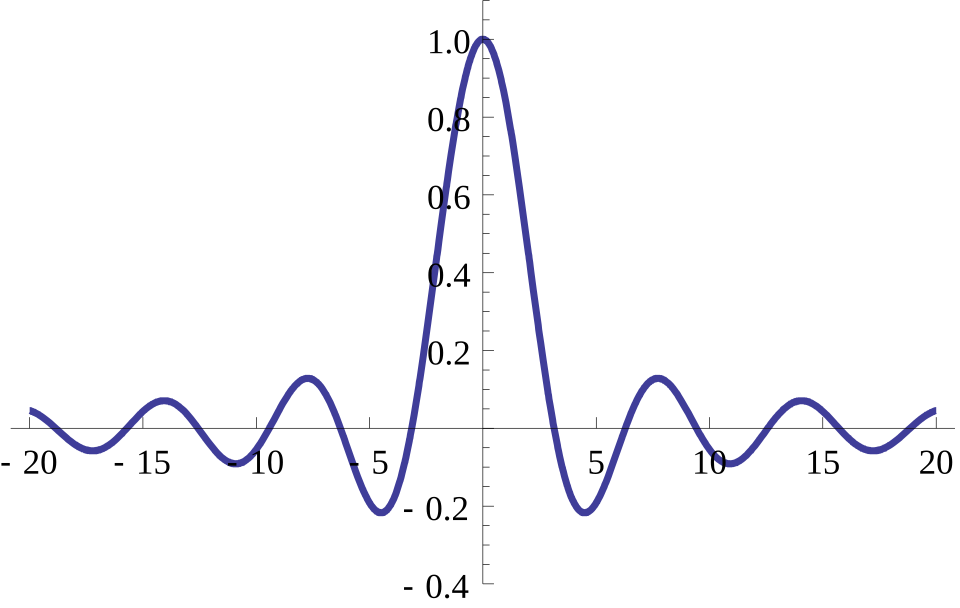
- lien avec Fonction génératrice des moments ? Comportements similaires, mais fonction caractéristique existe toujours
- mise en équation : $$\varphi_X:t\longmapsto{\Bbb E}[e^{itX}]=\int_{\Bbb R} e^{itx}f(x)\,dx$$
- propriétés :
- condition d'existence ? Toujours
- régularité ? Continuité uniforme sur l'espace entier
- \(\varphi(0)=\) \(1\)
- borne : \(\lvert\varphi(t)\rvert\leqslant\) \(1\)
- \(\varphi(-t)=\) \(\overline{\varphi(t)}\) (Fonction hermitienne)
- en particulier, la fonction caractéristique d'une v.a. réelle est paire
- \(\varphi_{X_1}=\varphi_{X_2}\iff\) \(X_1\overset{\mathcal L}= X_2\)
- permet d'obtenir les Moments de \(X\) : $${\Bbb E}[X^k]=\frac{\varphi^{(k)}_X(0)}{i^k}$$
- si \(X_1,\dots,X_n\) sont indépendantes, on a : \(\varphi_{a_1X_1+\dots+a_nX_n}(t)=\) \(\varphi_{X_1}(a_1t)\dots\varphi_{X_n}(a_nt)\)
- en particulier on a la caractérisation de l'Indépendance entre \(X\) et \(Y\) : $$X\;\bot\!\!\!\!\bot\; Y\iff\varphi_{(X,Y)}(s,t)=\varphi_{X}(s)\varphi_Y(t)$$
- \(\varphi_{aX+b}(t)=\) \(e^{itb}\varphi_X(at)\)
- fonctions caractéristiques usuelles :
- Loi dégénérée : \(\varphi_{\delta_a}(t)\) \(=\) \(e^{ita}\)
- Loi de Bernoulli : \(\varphi_{{\mathcal B}(p)}(t)\) \(=\) \(1-p+pe^{it}\)
- Loi binomiale : \(\varphi_{{\mathcal B}(n,p)}(t)\) \(=\) \((1-p+pe^{it})^n\)
- Loi binomiale négative : \(\varphi_{{\mathcal B}^-(n,p)}(t)\) \(=\) \((\frac p{1-(1-p)e^{it} })^n\)
- Loi géométrique : \(\varphi_{\mathcal G(p)}(t)\) \(=\) \(\frac p{e^{-it}-(1-p)}\)
- si on comptait le nombre d'échecs et par le nombre d'essais, \(\varphi_{\mathcal G(p)}(t)\) \(=\) \(\frac p{1-(1-p)e^{it} }\)
- Loi de Poisson : \(\varphi_{{\mathcal P}(\lambda)}(t)\) \(=\) \(e^{\lambda(e^{it}-1)}\)
- Loi Gamma : \(\varphi_{\Gamma(k,\theta)}(t)\) \(=\) \((1-it\theta)^{-k}\)
- Loi exponentielle : \(\varphi_{\mathcal E(\lambda)}(t)\) \(=\) \(1/(1-\frac{it}{\lambda})\)
- Loi de Laplace : \(\varphi_{\mathcal L(\mu,b)}\) \(=\) \(\frac{e^{it\mu} }{1+b^2t^2}\)
- Loi uniforme continue : \(\varphi_{\mathcal U([a,b])}(t)\) \(=\) \(\frac{e^{itb}-e^{ita} }{it(b-a)}\)
- Loi uniforme discrète : \(\varphi_{\mathcal U([\![ n,m]\!])}(t)\) \(=\) \(\frac{e^{itn}-e^{it(m+1)} }{(1-e^{it})(m-n+1)}\)
- Loi normale : \(\varphi_{\mathcal N(\mu,\sigma^2)}(t)\) \(=\) \(e^{it\mu-\frac12\sigma^2t^2}\)
- Loi du chi-deux : \(\varphi_{\chi^2(k)}(t)\) \(=\) \((1-2it)^{-k/2}\)
- Loi du chi-deux non centrée
- Loi du chi-deux généralisée
- Loi de Cauchy : \(\varphi_{\mathcal C(x_0,a)}(t)\) \(=\) \(e^{x_0it-a\lvert t\rvert}\)

